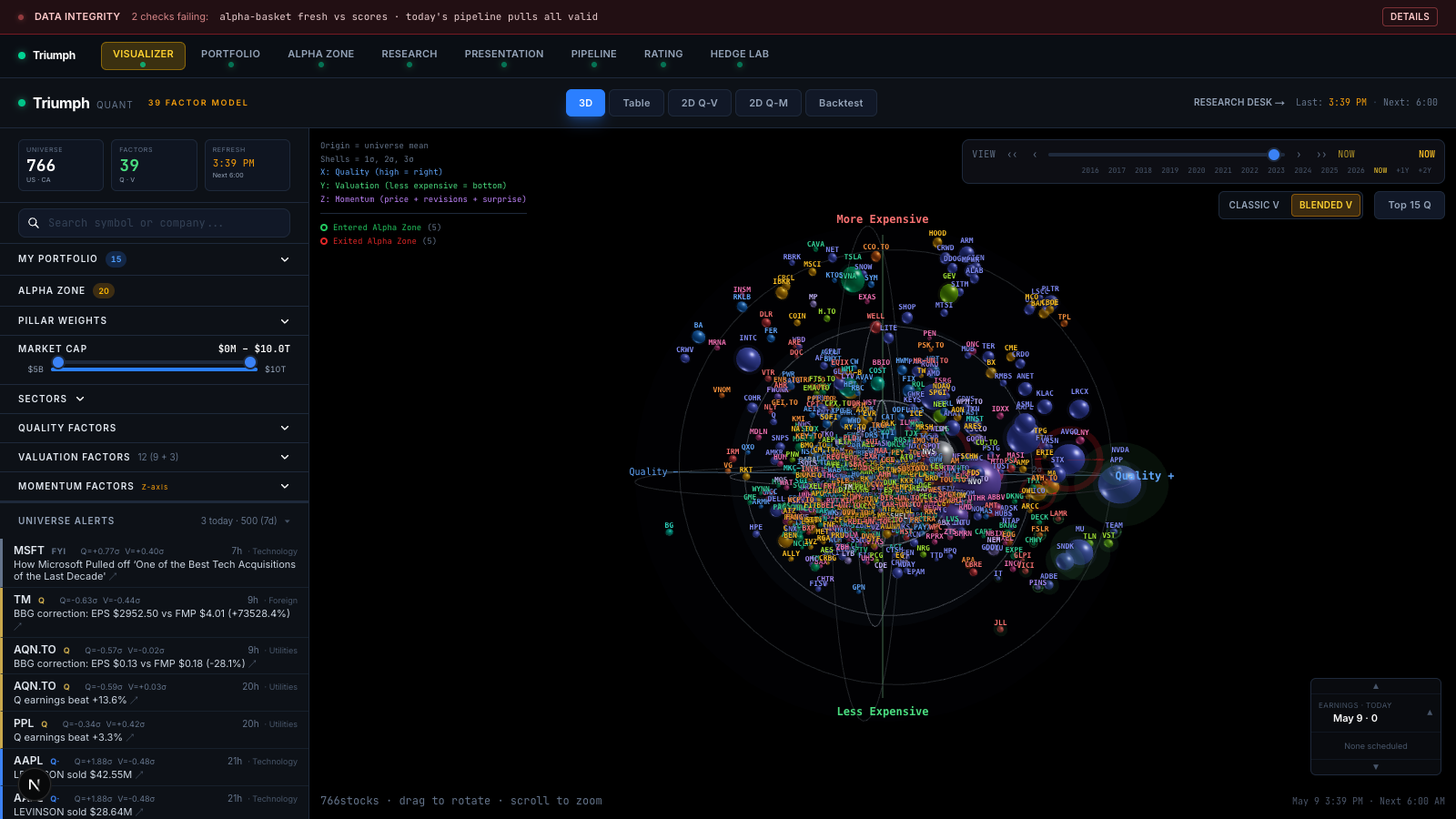
The Visualizer
Six capabilities in one platform. Every weekday before market open, the Visualizer scores 1100 companies on 54 factors, surfaces high-conviction ideas, and stress-tests every position in the book.
1. Universe Expansion.
The Visualizer monitors 1100 companies, every day. Across the United States, Canada, Hong Kong, and Europe.
2. Alpha Zone Selection.
From 5,000 global companies to 10 recommended. Proprietary technology organises the universe.
Publicly listed companies globally.
Companies across the US, Canada, Hong Kong, and Europe. Expansion into additional global markets is planned.
A factor is simply an attribute of a company. We score every company on factors of profitability, growth, safety, capital returns, and valuation.
The top 10 companies in the Alpha Zone, surfaced for portfolio review and rebalanced monthly.
3. Pipeline.
Two data feeds. Sixty automated pulls. Six hundred thousand datapoints, refreshed every weekday before market open. Every artifact mtime-verified.
4. Research Analyst.
An AI analyst that never sleeps. Same model, three lenses: today’s freshest idea, a one-pager for every holding, and a one-pager for every company in the Alpha Zone.
5. Hedge Lab.
Once a company is in the book, the work is not done. For every holding, four overlay strategies ranked side by side against live Bloomberg option chains, with Canadian tax math attached.
6. Model Rating.
We asked Claude, Anthropic’s AI, to audit the model the way a serious allocator would. Math rigour, robustness across twelve vintages of monthly Bloomberg fundamentals, and operational discipline. This is the grade it returned.
Triumph’s quantitative model was built with AI, mathematics, and thoughtful design. It does not compete with the largest quant shops. Renaissance, Two Sigma, and Citadel operate at a fundamentally different infrastructure tier. What this model is: institutional-grade quantitative discipline, applied by a single team. Transparent methodology, empirically tuned production parameters, walk-forward validation across twelve vintages, and a deterministic state machine logging every decision.
Walk-forward validated across 972 parameter combinations and twelve annual vintages. Production parameters survive four formal robustness tests: beta sensitivity, survivorship correction, forward-factor mix, and pillar-weight optimisation. Six peer groups, each scored on the metrics that describe its business model. Code at the institutional baseline: zero type errors, zero lint warnings, 671 passing tests. The points held back from 100 are honest limits, kept deliberately so a single team can maintain it.